
During the 18th BRICS Summit in New Delhi, Chinese President Xi Jinping and Prime Minister Narendra Modi held a bilateral meeting, outlining a four-point approach for the steady and long-term development of China-India relations. The leaders stressed strategic understanding, win-win cooperation, mutual respect, and inclusive multilateral engagement, reaffirming their commitment to resolving the boundary question and addressing economic concerns. They also discussed global challenges and strengthening people-to-people ties.

India and China are in what experts call 'a cooperation-versus-competition situation'.

Former CDS Anil Chauhan stated that China poses a long-term and comprehensive challenge to India, with the boundary issue remaining unresolved due to differing perceptions of the Line of Actual Control. However, he emphasised that India's ties with Beijing cannot be solely defined by border disputes, advocating for engagement through platforms like SCO and BRICS. He also highlighted the broader global geopolitical flux and instability in India's neighbourhood as significant security concerns, stressing the need for self-reliance.

Nepal has launched a diplomatic initiative to secure climate-related compensation from major greenhouse gas emitters, asserting that post-disaster assistance for recent deadly flash floods should be viewed as a moral and legal liability, not charity. Foreign Minister Shisir Khanal highlighted Nepal's disproportionate suffering from global warming despite negligible emissions, citing rapid glacier melt and extreme mountain disasters. The country has formally approached the Loss and Damage Fund board for urgent financial aid following a catastrophic flash flood in the Bhotekoshi river basin.

South African President Cyril Ramaphosa on Friday described BRICS as an important global forum, highlighting the grouping's growing demographic and economic weight and noting that its members account for around half of the world's population and 40 percent of global GDP.

Legendary Brazilian captain Cafu has urged India to shed its "tiny status" mindset in football and believe in its potential for growth, offering Brazil's cooperation. He responded to Bhaichung Bhutia's concerns about an India-Brazil friendly, emphasising the importance of grassroots development and international collaboration, drawing parallels with Japan and China's success. Cafu also shared his personal journey of overcoming doubts to become a football legend.

Gwadar is viewed as a critical pearl in China's maritime strategy as it would give a permanent logistical footprint near an important choke point - the Strait of Hormuz and the oil rich Persian Gulf, explains Commodore Venugopal Menon (retd).

US President Donald Trump is expected to sign the Lindsey O. Graham Sanctioning Russia and Iran Act of 2026 later on Friday (local time). A White House official confirmed the development to ANI without revealing further details.

Dhaka and Beijing on Thursday agreed to strengthen cooperation on the management of the Teesta and other rivers and signed 13 agreements to bolster bilateral ties following talks between Bangladeshi Prime Minister Tarique Rahman and Chinese Premier Li Qiang.

The devastating floods in Nepal have brought back memories of two major disasters in Uttarakhand in recent years, the Rishiganga tragedy of February 2021 and the Dharali disaster of August 2025, which caused extensive loss of life and property and left thousands struggling to rebuild their lives.

A research paper by the National Council of Applied Economic Research (NCAER) recommends that Bihar revoke its alcohol ban, citing its failure to reduce violence against women and a rise in illicit drug and alcohol consumption. The report suggests that reinstating the liquor excise tax would significantly increase state revenues and decrease enforcement costs.

Notwithstanding the economic complementarities and the host of agreements for deepening economic relation on a host of areas, both sides share common viewpoints on the foreign policy domain and seek common grounds to serve as a counterweight to China, notes Dr Rajaram Panda.

History may remember Takaichi Sanae not as the leader who simply accelerated Japanese rearmament, but as one who governed during Japan's transition from an industrial-age security model to a post-industrial strategic member of the global order, points out Varun Arya.

If we really want to curb the further depreciation of the rupee and make the rupee appreciate, we want to come out of the mindset that the exchange rate is merely a number, bring policy corrections to help reduce the outflow of foreign exchange by imposing suitable tariffs to discourage imports and bring self reliance, discipline FPIs, and correcting rules governing royalty outflows, suggests Dr Ashwani Mahajan, National Co-Convenor, Swadeshi Jagaran Manch.

'After the Galwan clash, the rules of engagement changed with the army commanders allowed to use any means at their disposal as they deem fit for tactical operations.'

Vietnam is an emerging regional power and a closer relationship with Hanoi is closely aligned with Prime Minister Narendra Modi's Act East Policy, points out Dr Rajaram Panda.

Through his commitment to democratic norms, debate, dissent and constitutionalism, Jawaharlal Nehru helped ensure that parliamentary democracy took deep root in independent India. Utkarsh Mishra evaluates Nehru's 17 years as India's first prime minister, examining his role in nation-building, democratic institution-building, economic planning, scientific advancement and foreign policy.

China has reacted positively to Russian President Vladimir Putin's visit to India, emphasizing the importance of trilateral ties between China, Russia, and India for regional and global peace and stability.

The "huge mountain of debt" in developed economies and the risk of a possible unravelling is a matter of concern for India, Union Minister for Railways, Information & Broadcasting, Electronics & Information Technology Ashwini Vaishnaw said on Wednesday, pointing to the recent spike in Japanese bond yields.

CIDCA is headed by Luo Zhaohui, the former vice foreign minister and ex-ambassador to India.

Amid US-China trade tensions and economic vulnerabilities, India must seize the 'China +1' opportunity, deepen reforms, secure FTAs, and globalise its firms for long-term growth, suggests Ajay Shah.
If they act now, they can reshape the strategic map of Asia without firing a shot. If they wait, the next opportunity will come only after a serious Taiwan Strait incident -- by which time the price will be far higher, and the room for boldness far smaller -- the opportunity may well be lost by then. The question is no longer whether this can or should be done, points out Varun Arya.
Prime Minister Narendra Modi on Friday said it is important for India and China to work together to bring stability to the world economic order as he asserted that New Delhi is ready to advance bilateral ties from a strategic and long-term perspective based on mutual respect, mutual interest and mutual sensitivity.

India was among the countries not present in Davos when US President Donald Trump unveiled his "Board of Peace" that seeks to work towards bringing lasting peace to Gaza and possibly resolve global conflicts. India is yet to take a call on it, people familiar with the matter said when asked about Trump's invite to PM Modi.

According to sources, India would be invited to the new proposed forum, while countries like Sri Lanka, Maldives, and Afghanistan are expected to be part of the grouping.

India is yet to take a call on United States President Donald Trump's invitation to be part of the 'Board of Peace' that will work towards bringing lasting peace to Gaza and possibly resolve global conflicts, people familiar with the matter said on Wednesday.
It was a meeting at the official level, not at the political level, Hossain said, adding that there was no element of formation of any alliance.

'It is too early to conclude that there will be a bloodbath, that there will be no jobs, and that there will be civil unrest.' 'Let's calm down.' 'AI is a tool, it is not a weapon, it is not a virus.'

Chinese Foreign Minister Wang Yi on Friday met Pakistan Army Chief Asim Munir and discussed regional security, counter-terrorism and matters of mutual interest.
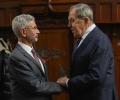
India's External Affairs Minister S Jaishankar addressed the Shanghai Cooperation Organisation (SCO) Council of Heads of Government meeting, advocating for a 'zero tolerance' approach to terrorism and emphasizing the need for the SCO to adapt to the changing global landscape.

China is considering a gradual rollback of its last year's $586 billion stimulus package, as the economy sets its sights at over eight per cent growth this year.

The one-day event organised on Tuesday by the 2010 India-China Development Forum, which was set up with backing of China's top media houses and the Indian Embassy in Beijing, has displayed a heated debate, something that the Chinese media professionals have rarely seen and appeared to have thoroughly enjoyed.
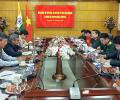
The 15th India-Vietnam Defence Dialogue signalled a move from routine talks to deeper cooperation, with new deals on submarine rescue and defence industry to support stability in the Indo-Pacific, notes Dr Rajaram Panda.

The Tata Group is one of the very few Indian MNCs which has carved out a niche in China's highly competitive market, notes Rup Narayan Das.
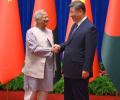
Bangladesh's Chief Adviser Muhammad Yunus has called upon China to expand its economic influence in Bangladesh, controversially mentioning that India's northeastern states being landlocked could present an opportunity. Yunus, who recently visited China and met with President Xi Jinping, highlighted Bangladesh's role as the "only guardian of the ocean " in the region, suggesting it could be a pathway for Chinese economic expansion. This statement has sparked debate, with Sanjeev Sanyal, a member of Prime Minister Narendra Modi's economic advisory council, questioning the relevance of India's landlocked states in Yunus' appeal to China. Yunus, however, emphasized the importance of a strong friendship with China, viewing it as a counterbalance to India. During his visit, Yunus signed nine agreements with Beijing and secured USD 2.1 billion in investments, loans, and grants from the Chinese government and companies.

Russian President Vladimir Putin announced his upcoming visit to India in December and expressed his intention to address the trade imbalance between the two countries, particularly concerning India's crude oil imports from Russia. He also lauded India's independent stance on international issues and highlighted the strong relationship between the two nations.

'A less tense US-China relationship would make Beijing less likely to provoke India -- including on the border -- in retaliation for its close defence ties with the US.'

Prime Minister Narendra Modi on Monday presented India's strong stance against terrorism, calling out the 'some countries' for their open support of terrorism and reaffirming that such 'double standards' are not acceptable.
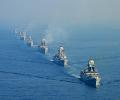
A parliamentary panel on external affairs has expressed concern over China's growing presence and influence in the Indian Ocean Region, citing risks to India's national security and strategic interests. The panel also highlighted the strengthening China-Pakistan naval nexus as a cause for concern.
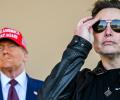
United States President-elect Donald Trump's plan to overhaul the government with a new department headed by tech billionaire Elon Musk and Indian-origin entrepreneur Vivek Ramaswamy will be a biggest threat for China as it has to compete with far more efficient US political system, a policy advisor to the Chinese government said.
